
By Sheryl Swingley—
MUNCIE, IN—Inspired by documentarian Ken Burn’s recent work, “The American Revolution,” Stan Sollars, recently reminded his audience that they are not subjects, but citizens with freedoms, a concept that didn’t exist before the 13 American colonies declared independence from Great Brittain.
Before the revolution and the U.S. Constitution, everyone was known as subjects of the ruling class.
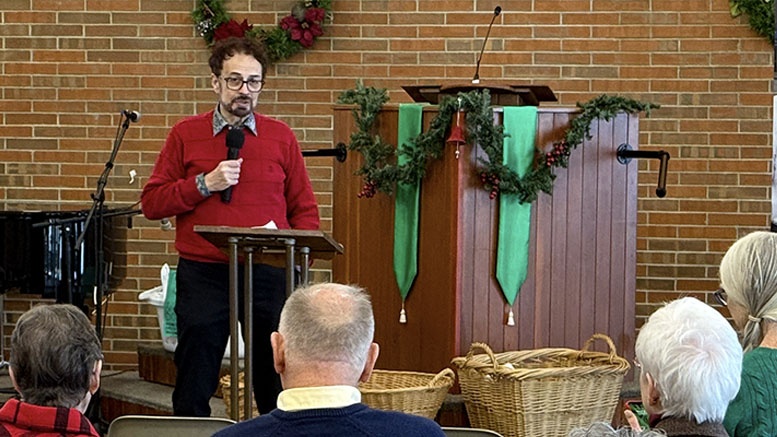
Sollars, who is Indiana Public Radio’s morning host during NPR’s “Morning Edition,” was the speaker on Dec. 6 for nearly 40 people in attendance at the League of Women Voters of Muncie-Delaware County’s annual holiday gathering, co-hosted by the American Association of University Women Muncie Branch. His presentation was titled “Why We Have Public Broadcasting.”
When examining the formation of the United States, Sollars reviewed important dates:
–The Declaration of Independence was signed on July 4, 1776.
–The U.S. Constitution was signed on Sept. 17, 1887.
–The U.S. Constitution was ratified by the nine states required on June 21, 1788.
–The Bill of Rights, which included 10 amendments, was ratified Dec. 15, 1791.
He then reminded his audience of the 45 words that make up the First Amendment, which is sacred to him.
He read aloud, “Congress shall make no law respecting an establishment of religion, or prohibiting the free exercise thereof; or abridging the freedom of speech, or the press; or the right of the people to peaceably assemble, to petition the government for a redress of grievances.”
It’s the First Amendment that enabled public broadcasting to be developed in Muncie, believes Sollars.
“Without help from Ball State University and Edmund Ball, a bunch of 20-something young moms, with their freedoms, asked for help and put public television on the air [in Muncie]. It was so they could get “Sesame Street” and “Mister Rogers,” on the air for their children,” Sollars said.
Early on, some cities and states operated radio stations as government services. Elsewhere, hobbyists went on the air ahead of government regulation from the Department of Commerce – and later the Federal Radio Commission and the Federal Communications Commission. These were the sum of broadcasting’s building blocks in the early days along with educational radio.
“So why do we have public broadcasting?” Sollars asked. “We have it for the same reason we have public schools and public libraries.”
These three entities are nonprofits, which means they operate in the public’s interest. They don’t make money for owners or stockholders.
Public schools, public libraries and public media are needed by people, but difficult to monetize.
Sollars added, “Unless there is some form of aggregate funding from the public through their governments and from their own wallets and other sources, nonprofits would not exist.”
What would the world be without nonprofits: hospitals, health clinics, YMCAs, YWCAs, homeless shelters and more?
Public broadcasting started as educational broadcasting in radio. Indiana’s oldest continuously operating radio state is WBAA-AM at Purdue University. The U.S. Department of Commerce licensed the station on April 4, 1922.
WBST-FM, now better known these days as IPR, signed on at Ball State in 1960.
The Ford Foundation was instrumental in funding National Educational Television, the predecessor of the Corporation for Public Broadcasting. The Ford Foundation handed over funding of PBS and NPR when President Lyndon B. Johnson signed the Public Broadcasting Act of 1967.
In July, however, the U.S. Congress withdrew funding from PBS and NPR as did Indiana’s General Assembly during the 2025 legislative session.
Sheryl Swingley, president of the AAUW Muncie Branch, said, “We invited Stan to speak because of his more than 30 years of service to the Muncie community through his work in public media and at IPR. We also want to keep Stan on the air. Many of our members give money to IPR and WIPB-TV, the local PBS station. We hope others will join us in supporting our local IPR and PBS stations.”
The League of Women Voters is a nonpartisan, grassroots, public policy and educational organization. It encourages informed and active participation in government. It influences public policy through education and advocacy. It does not support or oppose any political party or candidate. The League works to register and inform voters through the election resources of VOTE411.org and candidate forums. People of all different governing beliefs are eligible to join local chapters of the League of Women Voters. No invitation is needed to become a League member. To join the Muncie-Delaware County League, go to this site.
AAUW is the nation’s leading organization for equity in higher education and women’s
economic empowerment. Founded in 1881 by women who defied society’s conventions by earning college degrees, AAUW, a nonpartisan organization, works to increase women’s access, opportunity and equity in higher education through research, advocacy and philanthropy. The AAUW Muncie Branch has awarded scholarships annually to Ball State and Ivy Tech Community College students since 1981. No invitation is needed to become an AAUW member. For membership information, contact President Sheryl Swingley, sswingley@bsu.edu. Learn more at aauw.org.
