

By Juli Metzger—
MUNCIE, IN—There is encouraging news in the latest data on children in Delaware County, but some of the numbers also show why local educators and youth advocates say their work cannot stop at the classroom door.
The 2026 Muncie State of the Child data overview, presented by the Indiana Youth Institute last week, shows that 96.6 percent of Delaware County children have health insurance, above Indiana’s 94.1 percent. The county also ranks among the state’s strongest for access to primary-care physicians and mental-health providers, with one mental-health provider for every 296 residents.
IYI researchers presented the 2026 KIDS COUNT® Data Book on Sept. 17 at the Ball State University Alumni Center. Local sponsors were the Heart of Indiana United Way, George and Frances Ball Foundation, Cradle to Career Muncie, and Ball State University Teachers College.
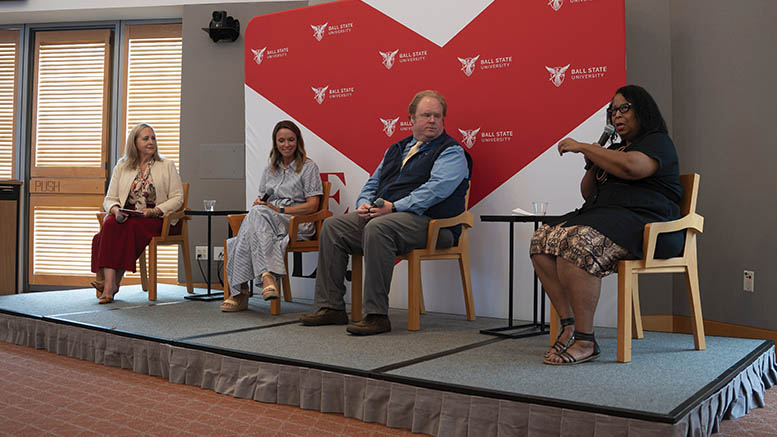
Tami Silverman, IYI’s CEO, and her team of data specialists led the discussion and moderated a panel of three local educators and youth advocates.
Mental health data illustrate the continuing need for services. Students reporting symptoms of depression dropped from 34.4 percent in 2022 to 27.8 percent in 2024. The percentage of students who reported seriously considering suicide declined from 17.9 percent to 13.7 percent.
Despite the improvements, more than one in four students still reported symptoms of depression.
Pastor Maria Wilson, executive director of the Bishop H. Royce Mitchell Hub at Urban Light in Muncie, said responding to those needs begins with listening rather than assuming what a young person needs.
“I’m a big believer in not telling people what they need, but asking, ‘How can I help you?’” she said. “That helps me to find out where they are as a person.”
Wilson also cautioned against equating insurance coverage with access to care.
“We’ve seen from the data that a lot of our children are covered by insurance,” she said. “But it doesn’t necessarily mean that they’re covered.”
She pointed to difficulties finding providers and connecting young people with services in ways they are willing to use.
“It’s not what we think is best for them,” she said. “It’s meeting them where they are at. What do you need?”
Delaware County’s chronic absenteeism rate was 21.9 percent in 2025, compared with 16.8 percent statewide. Its graduation rate fell from 94 percent to 87.5 percent, while the dropout rate increased from 4.1 percent to 7.5 percent.
Those challenges are especially important in a county where 20.4 percent of children live below the poverty line and 22.6 percent experience food insecurity.
Dr. Phil Boltz, director of accountability, reporting and data at Muncie Community Schools, said the larger lesson is that no organization can address those needs alone.
“I think there’s a temptation to think of schools narrowly as academic performance,” he said.
Boltz pointed instead to the interconnected role of home life, parental support and nutrition in educational outcomes.
That idea that schools, nonprofits, families and service providers work as a network was a recurring theme of the discussion. The numbers may measure children one outcome at a time, but children experience those challenges all at once.
Early childhood education was another focus of the discussion.
“If you’ve ever spent time with a 3- or 4-year-old before and after a year of preschool, you see a significant difference,” said Dr. Casey Smitherson, principal at South View Elementary School. “But you definitely see a significant difference in a child that is from an impoverished background.”
Smitherson pointed to benefits that extend beyond classroom instruction, including regular access to nutritious food and opportunities to build vocabulary.
“Imagine getting that student two extra years of schooling, two extra years of nutritious food, two extra years of increased vocabulary,” she said. “All of those things set the course for that child’s life.”
Juli Metzger, a former reporter, editor, publisher and journalism educator, is immediate past Chair of the Indiana Youth Institute Board of Directors.
